Prototype Manufacturing Cuts Jewelry Development Costs by 30%, Boosts Quality
The jewelry industry, built on a foundation of beauty and heritage, faces a modern paradox. The pursuit of exquisite craftsmanship and legacy is often undermined by antiquated development methods. Designers grapple with slow iteration cycles, unpredictable cost overruns, and inconsistent quality. Traditional hand-sculpting and casting methods, while artisanal, are prone to human error, leading to prototypes that fail to capture the precise elegance of the original vision. This disconnect between concept and creation results in wasted precious materials, delayed collections, and compromised product integrity.
This article explores how modern prototype manufacturing serves as the critical bridge. By leveraging digital precision, rapid iteration, and certified quality management systems, jewelry designers can transform their development process, achieving a 30% reduction in costs while elevating the final quality and fidelity of their pieces, ensuring a seamless journey from inspired sketch to heirloom-worthy reality.
What is Prototype Manufacturing and How Does It Apply to Jewelry Design?
Prototype manufacturing is the process of creating a preliminary, functional model of a product to evaluate its design, functionality, and manufacturability before full-scale production. In the context of jewelry, it represents the crucial transition from a 2D sketch or 3D CAD model into a tangible, wearable object. This stage is where the abstract concepts of elegance, proportion, and detail are physically tested and refined.
The Evolution from Wax to Digital:
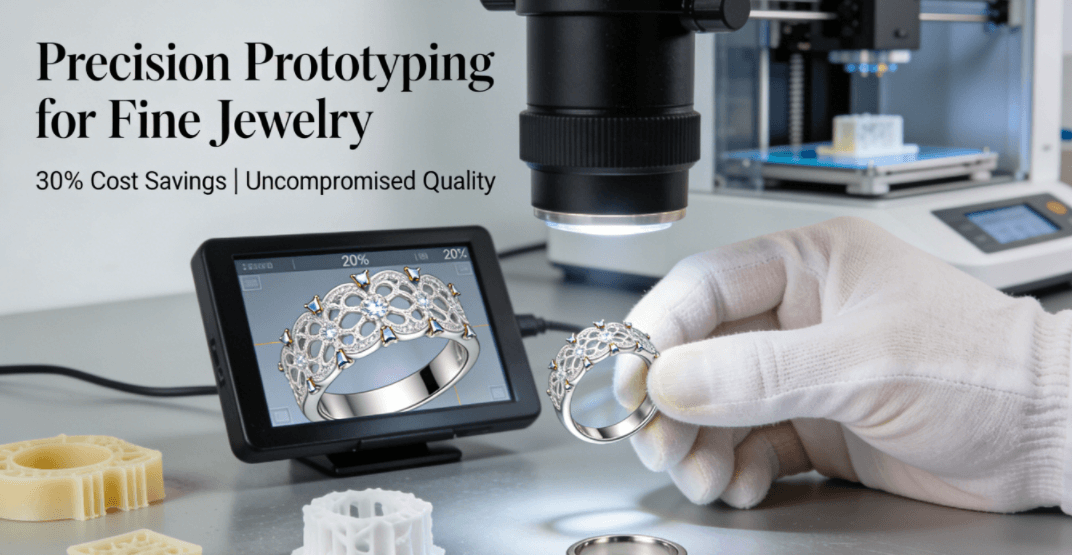
Historically, jewelry prototyping was synonymous with hand-carved wax models — a skill-intensive and time-consuming art. The digital revolution has transformed this. Today, Jewelry Prototyping begins with a precise 3D computer model. This digital file acts as the single source of truth, enabling a variety of high-fidelity output methods, from 3D printing in resin or wax to direct CNC machining of metals. This shift ensures unprecedented accuracy and repeatability, allowing designers to verify intricate details like prong alignment, stone settings, and surface textures long before committing to precious metals.
The Core Purpose: Validation and Refinement:
The primary goal of a prototype is to de-risk the final production. It allows designers and clients to assess the ergonomics, weight, and visual appeal of a piece. Can the ring shank be comfortably worn all day? Does the pendant sit correctly on the neck? Are the gemstone settings secure and proportionally pleasing? Answering these questions with a physical model prevents costly mistakes in the final, valuable production run. A systematic approach to this phase, governed by principles akin to those in a certified quality management system, ensures consistency and objective evaluation at every iteration.
Enabling Creative Confidence and Client Collaboration:
A high-quality prototype is a powerful communication tool. It transforms subjective descriptions into an objective, holdable artifact. This builds client confidence by providing a clear vision of the final product, facilitating feedback on tangible elements rather than interpretations of a rendering. For designers, it provides the creative confidence to pursue more complex, innovative designs, knowing there is a reliable, precise process to realize them, as detailed in comprehensive resources on the prototype manufacturing process.
How Can Precision Prototyping Enhance Elegance and Quality in Jewelry Pieces?
In luxury jewelry, the difference between a good piece and an exceptional one is measured in microns. Precision manufacturing technologies elevate prototypes from rough approximations to near-perfect representations, directly enhancing the perceived and actual quality of the final piece.
Capturing Microscopic Detail and Complex Geometry
The allure of fine jewelry often lies in its intricate details: fine milgrain edges, delicate filigree, and perfectly calibrated gemstone settings. High-resolution 3D printing and micro-precision CNC milling can reproduce these features with an accuracy unattainable by hand. This ensures that the prototype faithfully represents the designer’s intent, allowing for the refinement of elements that contribute directly to a piece’s unique character and elegance. A flawless prototype sets the standard for the master model used in production.
Achieving Superior Surface Finish for Aesthetic Appeal
The surface finish of a jewelry piece is paramount to its beauty and perceived value. A prototype with a rough, porous surface cannot accurately predict the luster of a polished final piece. Advanced prototyping methods, followed by skilled hand-finishing, can achieve mirror-like polishes and specific matte or textured finishes. This allows designers to make critical decisions about light reflection, tactile feel, and overall aesthetic harmony early in the process. Referencing industry standards for surface roughness provides a common language for specifying and achieving the desired finish.
Ensuring Structural Integrity and Wearability
Elegance must be paired with durability. A prototype is a functional test for structural soundness. Will a thin band withstand daily stress? Are the soldering joints on a complex necklace design robust? Using engineering-grade resins or direct metal prototypes allows designers to perform stress tests, check clasp mechanisms, and assess the longevity of the design. This proactive approach to quality assurance prevents failures in the final precious metal piece, protecting both the manufacturer’s reputation and the customer’s treasured possession.
What Are the Different Types of Prototype Manufacturing Suitable for Luxury Jewelry?
Selecting the right prototyping technology is a strategic decision that balances fidelity, speed, and cost. Luxury jewelry demands processes capable of capturing artistry while providing the necessary feedback for production readiness.
Stereolithography (SLA) and Digital Light Processing (DLP) 3D Printing
These vat polymerization technologies are the workhorses of modern jewelry prototyping. They use a laser or projector to cure liquid photopolymer resin layer by layer, producing parts with extremely high resolution and smooth surface finish. Ideal for creating intricate, detailed models for visual appraisal, fit tests, and creating master patterns for investment casting. The speed and accuracy of these systems make them perfect for the rapid iteration of complex designs.
Direct Metal 3D Printing (DMLS/SLM)
For prototypes that must embody the final material properties, Direct Metal Laser Sintering is revolutionary. It builds parts layer by layer from fine metal powder, fusing it with a laser. This allows for the creation of fully dense, complex jewelry pieces in sterling silver, gold, or platinum alloys directly from a CAD file. It is ideal for validating designs with challenging internal geometries, testing metal-specific finishing techniques, and creating limited edition or bespoke pieces without any tooling.
CNC Machining and Hybrid Approaches
In precision manufacturing, precision CNC milling creates prototypes by subtractive machining from solid blocks of material, such as wax, resin, or soft metal. It offers exceptional precision and outstanding surface finishes for specific geo+metries. An efficient strategy is to employ a hybrid approach. For example, cost-effective plastic or resin prototypes from Chinese plastic prototyping services can be used for initial morphology and fit testing. Once the design is finalized, high-fidelity wax or resin prototypes can be CNC machined or 3D printed as perfect master molds for the rubber molds required for the final investment casting production parts. Services specializing in such customized approaches are invaluable for optimizing the entire development process.
How Does Rapid Prototyping Accelerate Innovation and Reduce Time-to-Market for Jewelry Collections?
The fashion and luxury calendar waits for no one. Rapid Prototyping compresses the traditional jewelry development timeline from months to weeks, enabling faster innovation, more responsive design, and a significant competitive advantage.
Compressing the Design-Review-Iterate Cycle
In a traditional setting, a single design iteration involving hand-carving and casting could take weeks. With digital rapid prototyping, a designer can complete a 3D model, print a prototype, evaluate it, make CAD adjustments, and have a revised version in hand within 2-3 days. This accelerated cycle allows for exploring multiple design variations, fine-tuning proportions, and perfecting details without the pressure of immense time investment, fostering a bolder, more innovative design process.
Enabling Concurrent Development and Market Testing
Speed to prototype allows for parallel workflows. While one design is being prototyped, another can be in the detailing stage. Furthermore, high-quality prototypes can be used for pre-launch market testing — gathering feedback from focus groups, key retailers, or even through social media previews before committing to expensive production. This data-driven approach reduces the market risk of a new collection and ensures it resonates with the target audience upon launch.
Streamlining the Path to Production
A validated, production-ready prototype serves as the perfect master model. It can be used directly to create investment casting patterns or production molds. This eliminates the guesswork and potential errors introduced when transitioning from a rough model to a production master. By ensuring the prototype is 100% production-intent, the entire supply chain is streamlined, reducing lead times for manufacturing and enabling brands to bring timely, trend-relevant collections to market.
What Role Do Certifications Like ISO 9001 Play in Ensuring Prototype Quality for High-End Jewelry?
When the prototype is the blueprint for a valuable heirloom, confidence in the process is non-negotiable. International certifications provide an objective, audited framework that guarantees consistency, traceability, and a culture of quality throughout the prototyping journey.
- Process Standardization and Repeatability: A prototype supplier operating under a certified ISO 9001 Quality Management System doesn’t rely on chance. Every step — from file handling and build preparation to post-processing and inspection — is governe by document procedures. This ensures that the tenth prototype is identical in quality to the first, providing designers with reliable, predictable outcomes. This standardization is the bedrock of trust, especially when working remotely with manufacturing partners.
- Full Material Traceability and Documentation: For luxury jewelry, provenance matters. A certified system mandates strict control and traceability of materials. Whether it’s a specific grade of casting resin or a certify alloy for a metal prototype, its source and properties are document. Furthermore, the entire prototyping process for a specific design is record. This creates an unbroken chain of custody, which is crucial for quality assurance. Troubleshooting and protecting the intellectual property and legacy of a design.
- A Culture of Continuous Improvement: Certifications like ISO 9001 are not static awards; they mandate a culture of continuous improvement. Certified suppliers are require to regularly audit their processes, analyze non-conformities, and implement corrective actions. This means they are proactively refining their techniques, investing in better technology, and training their staff. For a jewelry designer, this translates to a partner who is consistently elevating their craftsmanship and capability, ensuring that the prototypes they receive are produce with the most advance and reliable methods available.
How Can Jewelry Designers Avoid Common Pitfalls with Strategic Prototype Manufacturing?
Even with advanced technology, the prototyping phase can be fraught with missteps that erode budgets and timelines. A strategic, informed approach helps designers navigate these challenges and maximize the value of every prototype.
Avoiding the “Over-Prototyping” Trap
A common pitfall is iterating endlessly on minor details without a clear decision-making framework. Strategy involves defining clear goals for each prototype phase (e.g., Prototype 1: Overall form and proportion; Prototype 2: Mechanism and wearability; Prototype 3: Surface finish and final detail). Stick to the goal for that phase, make decisions, and move forward. This disciplined approach prevents scope creep and cost escalation.
Selecting the Right Material and Fidelity for the Stage
Using a high-cost, high-fidelity process like direct metal printing for a very early concept model is wasteful. Conversely, using a low-resolution, brittle material for a final pre-production check is risky. The strategy is to match the prototype technology to the need. Early concepts can use fast, inexpensive plastic prototypes to check size and shape. Later, a high-resolution resin or wax model assesses detail. Finally, a metal prototype validates material behavior and finish. This tiered approach is the essence of cost-effective prototype solutions.
Designing for the Chosen Manufacturing Process
A design that looks stunning in CAD may be impossible to cast, finish, or set with stones. Engaging in early collaboration with the prototyping and production partner is crucial. They can provide Design for Manufacturability (DFM) feedback — suggesting minimum wall thicknesses, optimal draft angles, and feature sizes that ensure the design is not only beautiful but also producible. This collaboration safeguards the designer’s creative legacy by ensuring the final piece can be manufactured to the highest standard of quality.
Conclusion
Prototype manufacturing has evolved from a mere step in the process to the strategic linchpin of successful jewelry development. By embracing digital precision, rapid iteration, and certified quality systems, designers can transcend the limitations of traditional methods. This approach delivers uncompromising elegance and quality, fosters true innovation, and provides the financial control necessary to build a sustainable brand. Ultimately, a strategic investment in world-class prototyping is an investment in the designer’s vision, ensuring that each piece not only meets but exceeds expectations, securing its place as a cherished part of a lasting legacy.
FAQs About Prototype Manufacturing
What is the typical lead time for jewelry prototype manufacturing?
Lead times vary based on complexity and technology. For rapid prototyping using 3D printing, initial concept models can be deliver in 3-5 business days. More complex, high-fidelity prototypes for final validation may take 1-2 weeks. This accelerated timeline enables fast iteration and helps avoid critical project delays, allowing designers to stay agile.
How does prototype manufacturing ensure the quality of delicate jewelry designs?
Quality is ensured through a combination of high-precision technologies (like micron-accurate 3D printing) and systematic process control. Adherence to standards like ISO 9001 governs every step, from file verification to final inspection. This ensures intricate details are capture perfectly, surface finishes are evaluate accurately, and the prototype is a true and reliable predictor of the final product’s elegance and integrity.
What materials are best for jewelry prototyping?
The best material depends on the prototype’s purpose. Photopolymer resins are excellent for detail and speed. Specialty casting waxes are ideal for creating investment casting masters. For testing metal properties, direct metal prints in silver or steel are use. For cost-effective form and fit testing, high-quality engineering plastics offer a great balance of durability and detail.
Can prototyping help reduce costs in jewelry production?
Absolutely. By identifying and correcting design flaws, fit issues, and manufacturability problems early, prototyping dramatically reduces costly rework and material waste in full-scale production. Data indicates it can save up to 30% in total development costs by preventing errors from propagating to the expensive stages of precious metal casting and stone setting, making it a highly strategic investment.
Why are certifications important in prototype manufacturing for jewelry?
Certifications like ISO 9001 and IATF 16949 provide independent verification that a manufacturer operates a robust, repeatable quality management system. This guarantees process consistency, full traceability, and a commitment to continuous improvement. For high-value jewelry, this translates to confidence that the prototype — the blueprint for your legacy piece — is produce with the utmost reliability and attention to detail.
Author Bio
The author is a precision manufacturing expert at LS Manufacturing, a company that supports innovators and designers in bringing complex concepts to life through advanced prototyping and production technologies. With a quality system underpinned by international standards, the team is dedicated to helping jewelry designers and other creators achieve excellence, efficiency, and unparalleled quality in their development process. For a free project consultation to explore how prototype manufacturing can elevate your next collection, contact their specialists today.