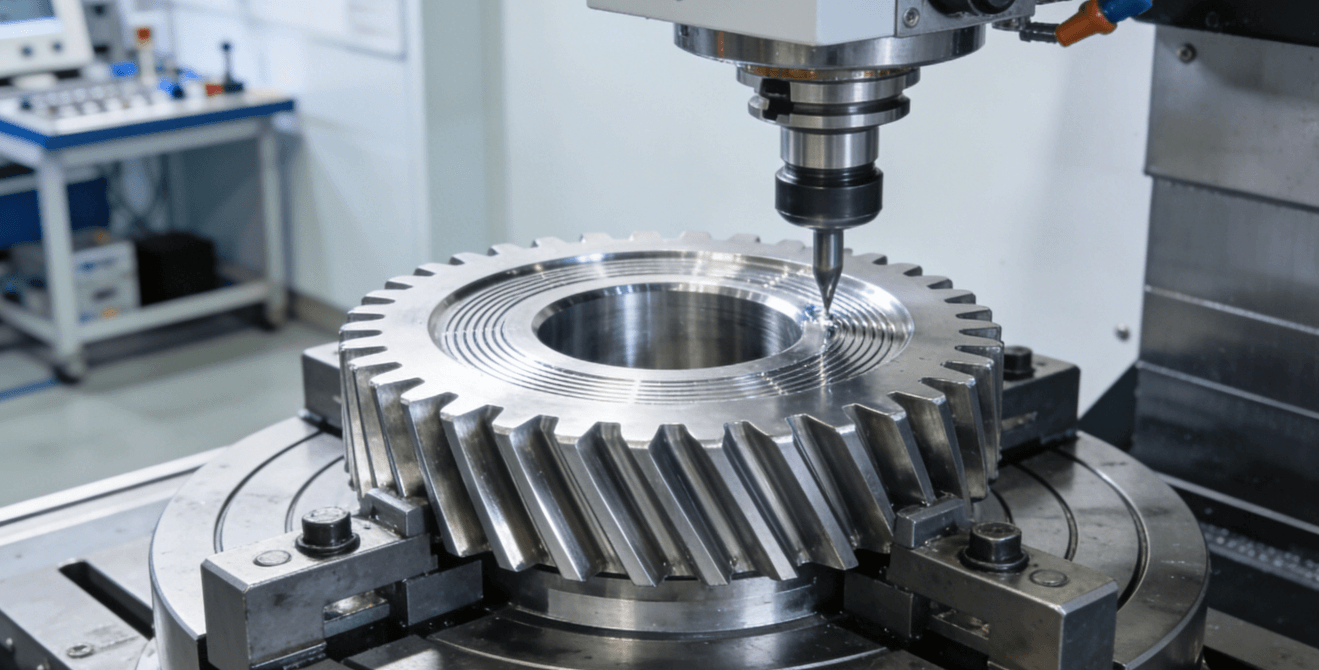
Breakthrough in Custom Gear Machining Precision Manufacturing Technology Reduces Robot Joint Errors by 40%
In industrial automation and aerospace, custom gear machining frequently encounters issues such as insufficient precision, extended production cycles, and quality fluctuations, leading to increased equipment failure and costs. The core problem lies in traditional gear manufacturing methods’ reliance on standardized processes, which lack the flexibility and high-precision control needed to meet personalized demands.
This article provides an optimized approach by integrating Precision Manufacturing Solutions with advanced gear machining technology, emphasizing custom design services and high-quality material selection. The following sections will provide an in-depth analysis of how to achieve this breakthrough.
What Are the Main Precision Challenges in Custom Gear Machining?
In high-stakes applications like robotic joints, Custom Gear Machining faces stringent precision requirements. Minor errors can lead to backlash, increased vibration, and premature wear, compromising the entire system’s lifespan and reliability.
Micro-Deviations in Tooth Profile and Pitch
The accuracy of a gear’s tooth profile and pitch is fundamental for smooth and efficient power transmission. According to standards from the American Gear Manufacturers Association (AGMA), high-precision gears often need to meet DIN grade 5 or higher. Traditional hobbing or shaping processes, influenced by tool wear and machine thermal deformation, struggle to maintain this micro-precision consistently on complex custom tooth forms, leading to noise and efficiency loss.
Dimensional and Shape Changes from Heat Treatment
- The Challenge of Distortion Control
Heat treatment is essential for enhancing gear durability and strength but often induces distortion. Non-uniform cooling or heating can cause tooth twisting and bore size changes, which are difficult to correct fully in subsequent steps.
- The Impact of Residual Stresses
Internal stresses remaining after heat treatment can gradually release during service, leading to dimensional instability or “aging deformation,” a critical threat for applications requiring long-term stability.
Inflexibility of Traditional Methods
Moreover, confronted with non-standard parameters, special profiles, or small-batch orders, traditional dedicated machines require lengthy setup and changeover times. This lack of agility is a key challenge modern custom gear manufacturing must overcome. Advanced Precision Manufacturing Solutions address this through digital custom design services, performing error compensation and process simulation at the programming stage to minimize deviations from the outset.
How to Optimize the Gear Manufacturing Process Through Precision Manufacturing Technology?
To address these challenges, modern gear production has fully embraced a precision technology system centered on CNC gear manufacturing, optimizing the entire process from design to finished product.
CNC (Computer Numerical Control) technology is the engine of the precision revolution. Five-axis CNC milling or form grinding can achieve micron-level accuracy in producing complex tooth forms directly, eliminating the need for dedicated tooling and greatly enhancing flexibility. Its digital nature allows for exact control and replication of machining parameters, ensuring batch-to-batch consistency, perfectly aligning with the demands of custom gear machining.
When combined with Rapid Production Techniques, such as efficient CAM programming, lead times from design to prototype are significantly shortened. This is crucial for product development and market responsiveness. Simultaneously, High-Quality Material Selection forms the physical foundation of performance. For instance, selecting high-strength, heat-resistant titanium alloys or specialty steels for aerospace applications, governed by ISO 9001 quality management systems, ensures reliability under extreme conditions. Manufacturers holding certifications like AS9100D offer greater credibility, ensuring full traceability and quality assurance from material to finished part.
How Does Industrial Gear Manufacturing Balance Cost and Quality?
In industrial gear manufacturing, balancing cost and quality is not a simple trade-off but an exercise in achieving value maximization through smart management and technological innovation.
Cost Control Through Lean Production
Implementing lean principles to optimize the gear manufacturing process can significantly reduce material waste, work-in-progress inventory, and non-value-added time. Strategies like high-speed machining to cut unit processing time or process optimization to minimize manual finishing lower overall costs without compromising quality.
A Total Lifecycle Cost Perspective
- Initial Cost vs. Operational Cost
High-quality gears may have a higher initial purchase price, but their superior wear resistance and longevity drastically reduce operational costs like downtime, maintenance, and energy consumption. AGMA data indicates that the total cost of ownership for a quality gear is often far lower than that of frequently replaced inexpensive gears.
- Long-Term Savings Through Reliability
Moreover, a true understanding of cost-effective gear machining must consider the equipment’s entire lifecycle. Investing in high-reliability gears translates to lower risk of failure and production stoppages, safeguarding production line continuity and ultimate profitability.
Customer Satisfaction Guarantee as a Core Value
Reliable manufacturers implement a Customer Satisfaction Guarantee to substantiate their quality commitments. This goes beyond replacing defective parts; it involves collaborative support from design and process validation to after-sales service. For example, professional custom gear machining services can advise on the most economical process-material combination, avoiding over- or under-engineering to achieve true value balance.
How Do Precision Manufacturing Solutions Enhance Gear Reliability?
Gear reliability directly determines the performance of the host equipment. Advanced Precision Manufacturing Solutions employ a systematic approach to design and build reliability into every gear.Custom Design Services are the first line of defense for reliability. Engineers use CAE software for load analysis and strength validation, optimizing tooth profiles to distribute stress evenly and avoid potential failure points at the design source. During manufacturing, CNC gear manufacturing ensures the design intent is replicated accurately.
Precise control of heat treatment and surface finishing is critical for enhancing durability. Processes like controlled atmosphere carburizing and nitriding precisely manage case depth and surface hardness, significantly improving resistance to pitting and wear. Rigorous gear reliability testing methods, including CMM inspection, surface roughness analysis, and rolling contact fatigue testing, form the final validation barrier. Moreover, manufacturers adhering to standards like ISO 14001 often demonstrate more disciplined process control, indirectly ensuring long-term product consistency and producing trustworthy transmission components.
What Are the Innovative Future Trends in Gear Machining?
The gear manufacturing industry is stepping into a new era of intelligence and sustainability, with innovative technologies continuously reshaping the landscape. Digitalization and the Digital Twin are core trends. Integrating sensors and IOT technology allows real-time operational data from gears to be fed back to the design end, creating a “digital twin” model used for predictive maintenance and next-generation product optimization. Reports from the Society of Manufacturing Engineers (SME) highlight that this data-driven closed-loop will significantly enhance product performance and reliability.
Rapid Production Techniques will evolve further to accommodate increasingly fragmented order demands. Hybrid additive-subtractive manufacturing (e.g., 3D printing for near-net-shape + CNC finishing) enables the production of topology-optimized gears with internal cooling channels or ultra-lightweight structures, ideal for low-volume, high-complexity components in sectors like aerospace. High-Quality Material Selection will expand to include composites and advanced specialty alloys to meet more extreme operating conditions.
Sustainable manufacturing principles will become deeply integrated into industrial gear manufacturing, encompassing the use of eco-friendly coolants, metal scrap recycling, and process optimization for reduced energy consumption. Industry leaders like CNC Precision are at the forefront, integrating these innovations to deliver gear solutions that are not only efficient and precise but also future-ready.
Conclusion
This article has systematically analyzed the core challenges in custom gear machining and demonstrated how the integration of precision manufacturing solutions—through high-precision CNC gear manufacturing, high-quality material selection, and custom design services—can holistically enhance gear precision, reliability, and cost-effectiveness. Embracing these advanced technologies and philosophies is key to gaining a competitive edge in the Industry 4.0 landscape.
Contact our engineering experts today to get a tailored gear machining solution that optimizes your manufacturing process and drives future efficiency!
Author Biography
CNC Precision is a leading precision manufacturing company specializing in high-complexity, high-accuracy custom component solutions. The company holds international certifications including ISO 14001, ISO 9001, IATF 16949, and AS9100D, boasting profound technical expertise and extensive project experience in industrial gear manufacturing and the aerospace sector, committed to ensuring excellence in customer product performance through innovative technology.