Lab-Grown vs Mined Diamonds: What Shoppers Should Actually Know Before Buying
If you’ve spent any time recently looking at engagement rings or fine diamond jewelry, you’ve probably noticed the lab-grown vs mined question comes up almost immediately. It used to be a niche conversation — something for people on tighter budgets who wanted to stretch their spend a bit further. That framing is well and truly outdated now.
Lab-grown diamonds now account for 52% of engagement ring center stones sold in the United States — a figure that barely registered at 12% just a few years ago. More than half. And yet plenty of people still walk into this decision without a clear picture of what actually separates the two, what doesn’t, and what should genuinely matter when choosing.
So here’s the honest version.
They are the same stone — chemically speaking
Start here, because everything else flows from it: a lab-grown diamond and a mined diamond are chemically identical. Same pure carbon, same crystal structure, same hardness of 10 on the Mohs scale. Same fire, same brilliance, same way of catching light.
A gemologist with standard retail equipment can’t tell them apart. You’d need specialist spectroscopy tools — the kind designed specifically to detect trace patterns from how each stone formed — to find a difference. To your eye, to anyone looking at your hand, to every single day of wear over the next few decades, they’re the same stone.
The only thing that differs is the journey. Mined diamonds take billions of years to form under enormous heat and pressure deep underground. Lab-grown diamonds recreate those exact conditions in a controlled setting — through High Pressure High Temperature (HPHT) or Chemical Vapor Deposition (CVD) — and arrive at the same result in a matter of weeks.
The price gap is now enormous
Back in 2016, lab-grown diamonds were priced around 30% below comparable mined stones. That gap has now blown out to roughly 80–85%. A 2-carat VS1 round lab-grown diamond sells for around $1,650–$2,800 right now. The mined equivalent? Somewhere between $15,000 and $25,000, sometimes more.
That’s not a marginal saving — it changes what’s actually possible with a given budget. Someone who’d have been stretching uncomfortably to afford a 1-carat mined stone can now look at a 2-carat lab-grown and still have money left for a setting they’re genuinely excited about, rather than whatever was left after the diamond ate the budget.
Worth knowing too: gold prices have climbed significantly over the past couple of years, so the setting itself costs more than it used to. Plan for the whole ring, not just the center stone.
Grading standards shifted recently — and it’s worth knowing
Most people shopping for diamonds don’t know this: GIA, the world’s most widely recognized grading authority, changed how it grades lab-grown stones recently. Previously, lab-grown diamonds got the same full 4C report as mined ones. The new system simplifies it into just two tiers:
- Premium: D color only, VVS clarity or better, excellent cut
- Standard: E–J color, VS clarity or better, very good cut
The reason is pretty straightforward — lab-grown diamonds are remarkably consistent. Unlike mined stones, which vary wildly across the quality spectrum, lab-grown ones tend to cluster in the upper grades. Around 95% fall within a fairly tight range, so the traditional 4C breakdown was designed for a level of variation that lab-grown stones just don’t produce.
Why does this matter for you? Because when you’re comparing certificates, context matters. A GIA report on a mined diamond reads differently from a GIA report on a lab-grown one. And IGI, which is the more common certification for lab-grown stones, uses its own grading language. Knowing this stops you from comparing apples and oranges and thinking you’re looking at the same thing.
What mined diamonds still genuinely offer
This isn’t going to be a one-sided case for lab-grown. There are real reasons people choose mined diamonds — reasons that go beyond tradition or not having done their research — and they deserve to be taken seriously.
Geological origin is one of them. Every mined diamond has inclusions, growth patterns, and characteristics that are entirely unique to that stone, shaped over billions of years in a specific place on earth. Lab-grown diamonds develop their own inclusion patterns too — HPHT stones sometimes show metallic inclusions, CVD stones can have tiny carbon spots — but they don’t carry the same deep-time origin story. If that history matters to you, if it’s part of what makes the stone meaningful, no amount of optical equivalence closes that gap. That’s a real preference, not a naïve one.
Resale value is another honest consideration. Lab-grown diamond prices have dropped around 70–80% since 2018 as production scaled and more labs entered the market. The secondary market for lab-grown stones is still developing, and prices are harder to predict than for mined stones. If you’re thinking of this purchase as something that holds monetary value over time, mined is the more dependable bet.
And the economic argument has more weight than people often give it credit for. Responsible mining supports real jobs and communities in the regions where it operates. For some people that matters alongside — or more than — the environmental side of the equation. It’s not a justification for ignoring ethics. It’s just the other side of a more complicated picture.
While we’re here: moissanite is worth a look too
If the diamond conversation is pushing your budget somewhere uncomfortable, moissanite is worth considering in its own right — not as a cheaper diamond stand-in, but as a stone with its own genuinely impressive qualities.
It has a higher refractive index than diamond (2.65 vs 2.42), which means more of those rainbow flashes — the fire — when light hits it at different angles. It scores 9.25 on the Mohs scale, which is more than adequate for daily wear including an engagement ring. And the price is a fraction of either diamond type.
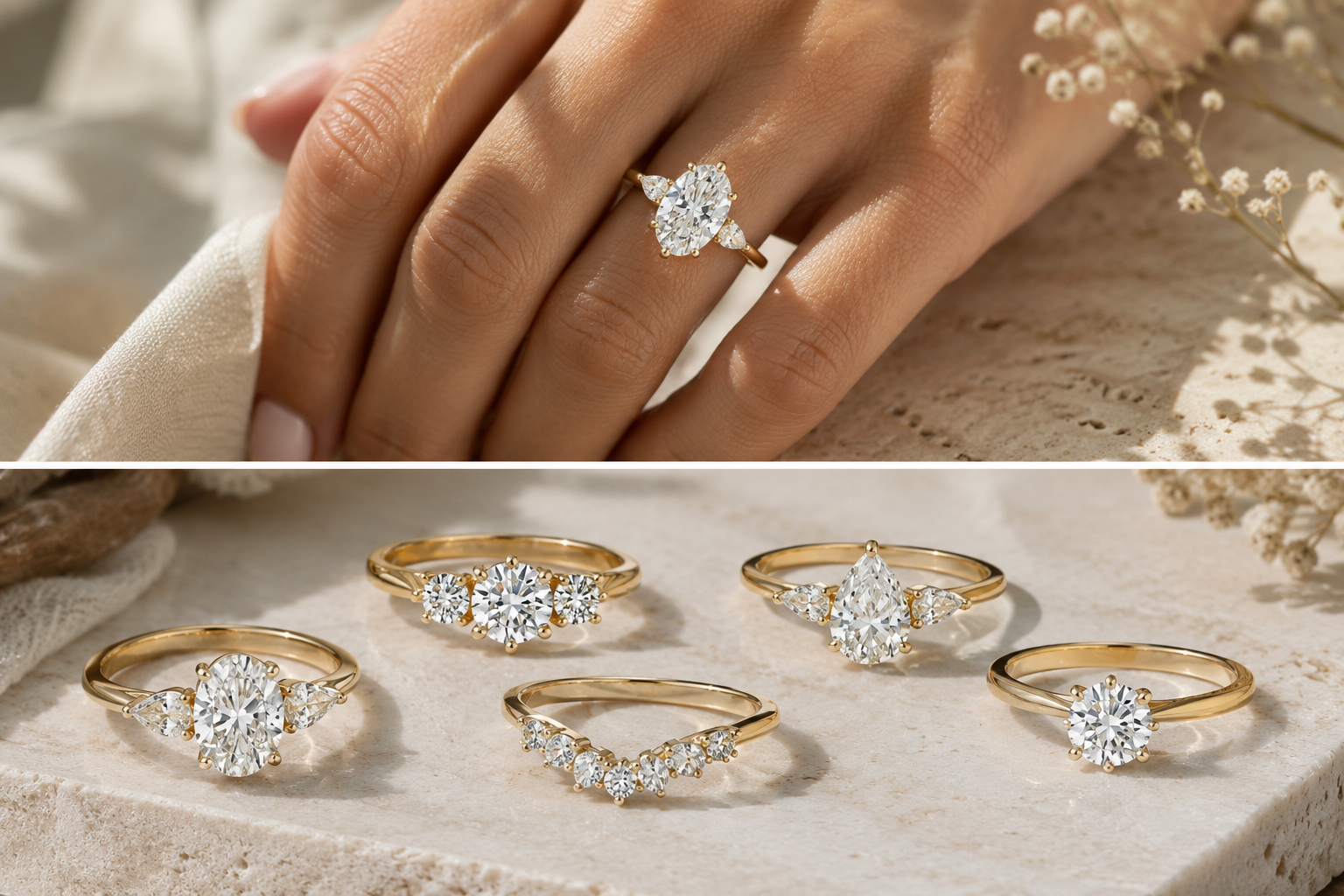
Jewelers like Romalar Jewelry carry a wide range of moissanite rings — from simple solitaires to more elaborate halo settings — so you can get a real feel for how it looks across different styles before deciding anything.
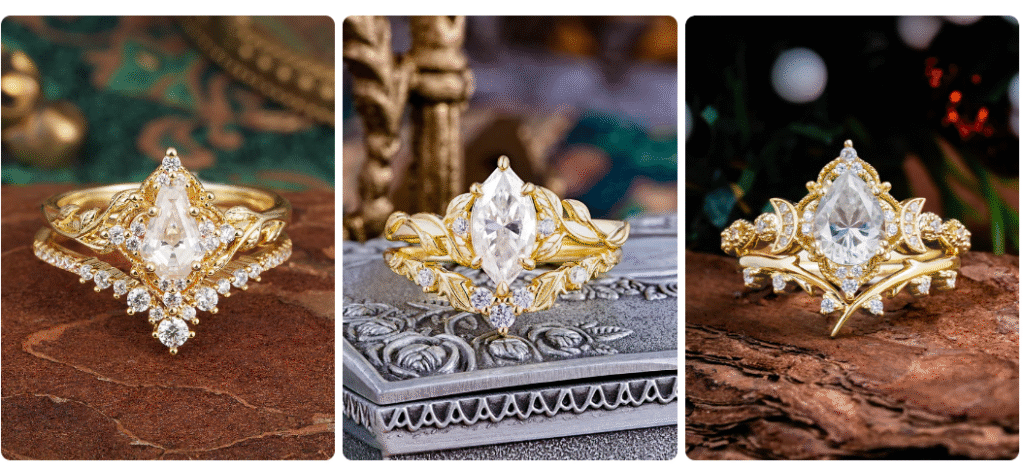
If you specifically want a diamond, chemically speaking, moissanite isn’t one. But if what you actually want is a stone that looks stunning, wears well, and gives you real room to think about the rest of the ring — the setting, the metal, the design details that make it yours — it’s well worth a serious look.
So what should actually drive the decision?
Honestly, a few things matter more than any comparison chart.
Does where the stone came from actually matter to you? Not as a vague idea — but in a way you’d still care about five years from now? If the geological history of the stone changes what it means to you, a mined diamond is worth the extra cost. That’s not sentimentality. That’s knowing what you value.
What do you want to do with the budget? If you’d genuinely rather have a bigger stone, a better setting, or just less financial pressure around a piece of jewelry — lab-grown gives you options mined simply doesn’t at the same price point.
Are you thinking about long-term monetary value? If yes, mined diamonds have a more predictable secondary market. If the ring is primarily being bought to be worn and loved for years, that consideration matters far less than it sometimes gets made out to.
And the one that probably deserves the most weight: what does the person actually wearing it care about? Not what convention says they should care about. Their real preferences, their actual values, what makes a ring feel like theirs. That question tends to get asked last. It should probably go first.
There’s no universal right answer here. What’s changed is that both choices now deserve to be made with real information — not assumptions that were formed a decade ago and haven’t been updated since.